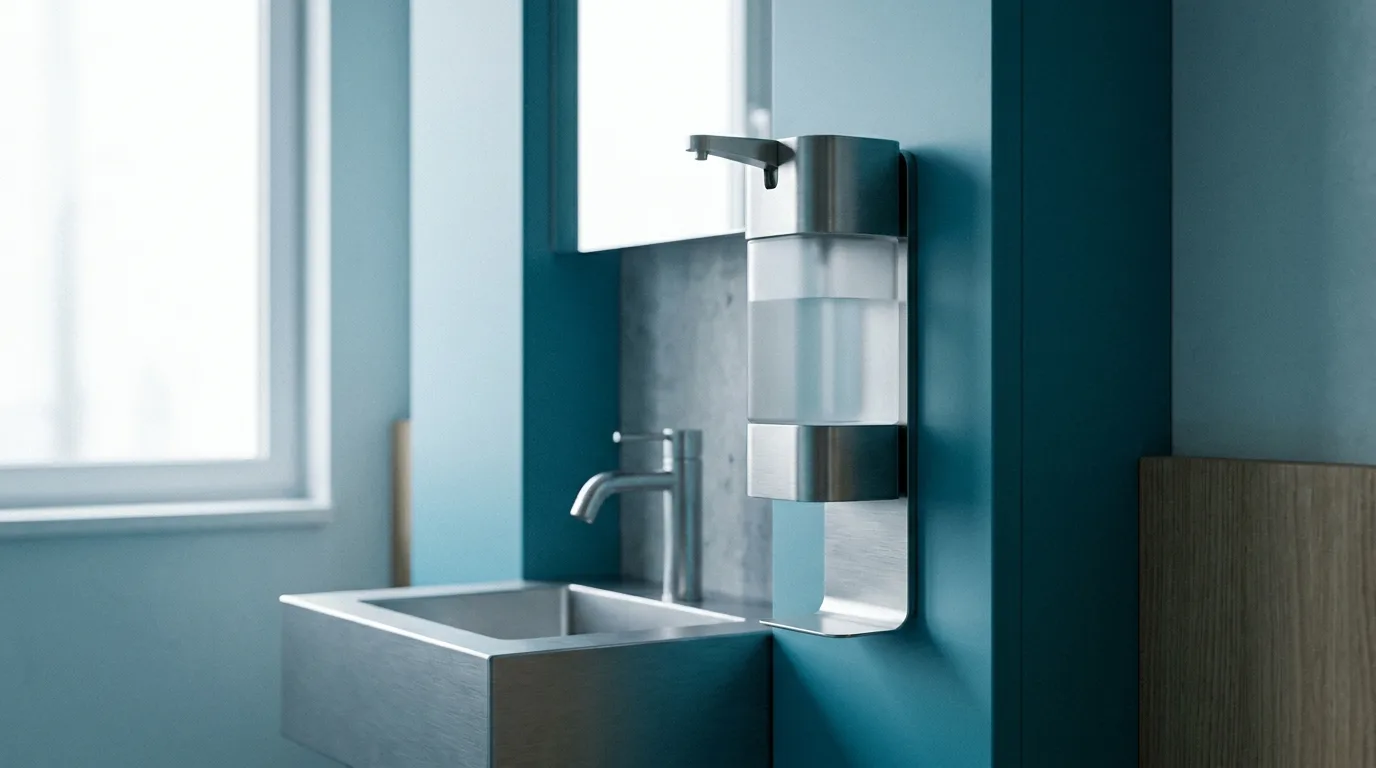
Alcohol-free hand sanitiser that is safe to issue in custody, and covers the threat.
Custody is a confined, over-crowded, high-transmission estate, and its standard hygiene tool, alcohol hand rub, is restricted on ingestion, self-harm, fire and contraband grounds.
We give you alcohol-free hand sanitiser that is independently tested to and passes the recognised European standards, including the sporicidal and virucidal standards for C. difficile and norovirus, and is non-flammable with no ingestion or contraband risk. So you close the hygiene gap the regulator's own guidance leaves open, and cover the pathogens that move fastest in a confined estate.
Independently tested to and passes the standards alcohol rub cannot meet, including the sporicidal and virucidal standards for C. difficile and norovirus, and non-flammable by formulation.
In short
What is alcohol-free hand sanitiser for prisons?
Alcohol-free hand sanitiser for prisons is a water-based, non-flammable hand-hygiene product for custody settings where alcohol gel is restricted on ingestion, self-harm, fire and contraband grounds. It carries no ingestion-toxicity or intoxication pathway, and is independently tested to and passes the recognised standards covering C. difficile and norovirus.
Removing the ingestion and unintended-use risk that leads UKHSA to restrict alcohol hand rub in prisons
Taking a Class I flammable liquid, and its fire and self-harm vector, off the estate
Closing the contraband and intoxication route alcohol gel carries in secure settings
Covering the bacterial, viral, fungal and spore-forming threats that spread fastest in a confined estate
Helping meet the duty of equivalence that says custody infection control cannot fall below the community standard
Easing the COSHH and DSEAR position your facilities team has to maintain
The challenge
A high-transmission estate, denied its primary hygiene tool
The duty of equivalence says infection control in custody cannot fall below the community standard. Yet the community's main hand-hygiene product is the one custody cannot safely use.
Prisons are classed as higher risk for respiratory transmission: confined, over-crowded and high-turnover, with the adult men's estate running at around 97.7% capacity and an outbreak declared on as few as two linked cases in five days. A single UK men's prison saw COVID-19 attack rates of 9.2% and then 18.7%. When infection moves, it moves fast.
But the standard tool is restricted. UKHSA infection-control guidance for adult prisons limits wall-mounted alcohol hand rub because dispensers carry a risk of ingestion and unintended use. Alcohol gel is also a Class I flammable liquid, pulling it into DSEAR and COSHH duties, and a documented intoxication, self-harm and contraband route in secure settings.
So the estate carries the community's infection risk under the duty of equivalence, while being denied the community's primary defence against it. That gap is not a preference, it is written into the regulator's own guidance, and it is what an alcohol-free option is built to close.
How it works
Covers the threat, in a form safe to issue
You get both: broad-spectrum protection across the pathogens that spread in a confined estate, and an alcohol-free, non-flammable form that is safe where alcohol gel cannot be used.
It is independently tested to and passes the recognised European hygiene standards, including the sporicidal and virucidal standards for C. difficile and norovirus, so it covers the bacterial, viral, fungal and spore-forming threats that move fastest in custody.
And because the active is alcohol-free and water-based, it is non-flammable and carries no ingestion-toxicity or intoxication pathway, removing the hazards that lead UKHSA to restrict alcohol hand rub and that make it a self-harm and contraband concern. It takes a Class I flammable liquid out of a secure estate, simplifying the DSEAR and COSHH position your residence and facilities teams manage. With a long shelf life, it suits controlled distribution across a confined estate, and it complements soap and water where national guidance requires it. One accountable partner specifies it and stands behind the evidence.
What you get
Covered, safe to issue, simpler to assure
Risk
No ingestion or contraband hazard
Alcohol-free, so it removes the ingestion and unintended-use risk that leads UKHSA to restrict wall-mounted alcohol hand rub in prisons, and the intoxication route alcohol gel carries.
Risk
Take a flammable liquid off the estate
Non-flammable, so it removes a Class I flammable substance from secure areas and the fire and self-harm vector that comes with it.
Risk
Cover the threats that spread
Broad-spectrum protection, independently tested to and passing the sporicidal and virucidal standards for C. difficile and norovirus, across the bacterial, viral and fungal threats that move fastest in a confined estate.
Obligation
Close the equivalence gap
An alcohol-free hand-hygiene option for the wings where alcohol products are restricted, helping you meet the duty of equivalence that says custody IPC cannot fall below the community standard.
Obligation
Simpler COSHH and DSEAR position
Removing a flammable, hazardous substance from working areas eases the fire, explosion and hazardous-substance assessments your facilities team has to maintain.
Obligation
Evidence for HMIP and CQC
Independently tested results against named recognised standards, and a clear safety rationale, for a joint HMIP and CQC inspection judging healthcare on community equivalence.
Evidence
Tested to standard, and led by the regulator's own restriction
The gap is written into prison IPC guidance. The alcohol-free alternative is independently tested and proven to standard.
Broad-spectrumIndependently tested to and passes the recognised European standards, including the sporicidal and virucidal standards for C. difficile and norovirus
Non-flammableRemoves a Class I flammable liquid and its DSEAR and COSHH duties from secure areas
RestrictedUKHSA limits wall-mounted alcohol hand rub in prisons on ingestion and unintended-use grounds, the gap this closes
The evidence
Why custody cannot rely on the standard tool
Regulator restriction
UKHSA restricts alcohol hand rub in prisons
Infection-control guidance for adult prisons limits wall-mounted alcohol hand rub to low-risk areas because dispensers carry a risk of ingestion and unintended use, leaving residents short of the hygiene tool the wider NHS relies on.
Transmission
Infection moves fast in a confined estate
A single UK men's prison recorded COVID-19 attack rates of 9.2% and then 18.7%, with an outbreak declared on as few as two linked cases in five days, in an estate running near full capacity.
Fire and self-harm
Alcohol gel is a flammable, hazardous substance
Alcohol hand rub is a Class I flammable liquid that triggers DSEAR and COSHH duties and is a documented intoxication and self-harm route in secure settings, a poor fit for a confined estate.
Compliance
The compliance you carry
The UK environmental and safety duties that commonly reach alcohol-free hand sanitiser for prisons. Open any one for what it requires, the deadlines, what is at stake, and how to evidence control. Every entry is sourced.
COSHH / DSEARRiskObligationFlammable-substance duties for alcohol hand rub (COSHH 2002 and DSEAR 2002)
What you must doRisk-assess the flammable and hazardous-substance exposure and control siting and storage; an alcohol-free, non-flammable product removes the substance from the assessment.
Applies toSettings storing and siting alcohol-based hand rub, a flammable liquid, especially secure and supervised environments.
When it bitesOn storing or wall-mounting alcohol-based hand rub near ignition sources or in fire- and self-harm-sensitive areas.
DeadlinesOngoing
What is at stakeEnforced under the Health and Safety at Work Act and these regulations, with civil sanctions and prosecution.
How to evidence itCOSHH and DSEAR assessments, controlled storage and siting, or removal of the flammable substance altogether.
Legal basisControl of Substances Hazardous to Health Regulations 2002 and the Dangerous Substances and Explosive Atmospheres Regulations 2002. Issued by Health and Safety Executive.
Take a flammable liquid out of a secure or supervised estate and simplify the COSHH and DSEAR position.
EquivalenceObligationRiskEquivalence of care (health and justice commissioning principle)
What you must doProvide infection control and hand hygiene at least equivalent to the community standard, despite the restriction of alcohol-based products in custody.
Applies toPrisons, secure settings and their commissioned healthcare providers.
When it bitesContinuously; healthcare for detained people must be at least consistent with that in the wider community.
DeadlinesOngoing (continuous duty)
What is at stakeAssessed through CQC and HMIP inspection rather than fines; an equivalence gap is a primary inspection criticism.
How to evidence itHand-hygiene provision that does not fall below community standard, even where alcohol products are restricted.
Legal basisNHS England Health and Justice commissioning principle of equivalence of care. Issued by NHS England Health and Justice.
Close the hand-hygiene gap the restriction leaves, meeting the equivalence duty inside the wing.
UKHSA prisons IPCObligationRiskUKHSA infection prevention and control guidelines for adult prisons
What you must doFollow the operational IPC guidance, including the restriction of wall-mounted alcohol hand rub on ingestion and unintended-use grounds, and manage outbreaks from two linked cases in five days.
Applies toAdult prisons and secure settings and their healthcare and operational teams.
When it bitesContinuously, covering hand hygiene, outbreak thresholds and the restriction of wall-mounted alcohol hand rub.
DeadlinesOngoing
What is at stakeAssessed through CQC and HMIP inspection and outbreak escalation rather than fines.
How to evidence itHand-hygiene provision consistent with the guidance, outbreak plans, and a safe alternative where alcohol rub is restricted.
Legal basisUKHSA infection prevention and control guidelines for adult prisons and management of outbreaks in secure settings. Issued by UK Health Security Agency.
Provide hand hygiene the guidance allows in restricted areas, closing the gap its own restriction creates.
CQC / HMIPObligationRiskCQC and HMIP inspection of secure-setting healthcare
What you must doDemonstrate safe, equivalent healthcare including infection control; critical findings and Urgent Notifications carry reputational and political weight.
Applies toHealthcare services in prisons, YOIs and immigration removal centres.
When it bitesOn the inspection cycle; CQC and HMIP inspect jointly against community-equivalent care.
DeadlinesOngoing (inspection cycle)
What is at stakeEnforcement and registration action from CQC, and Urgent Notifications from HMIP.
How to evidence itIndependently tested evidence and a clear safety rationale for the hand-hygiene products in use across the estate.
Legal basisCQC registration of secure-setting healthcare and HM Inspectorate of Prisons healthy-establishment inspection. Issued by Care Quality Commission / HM Inspectorate of Prisons.
Carry independently tested evidence into a joint inspection judging healthcare on community equivalence.
What you must doUse only hand-hygiene products lawfully placed on the GB market under the biocidal products regime, and confirm authorisation before procurement.
Applies toAnyone placing a hand sanitiser on the GB market, across health, care, custody and education buyers specifying one.
When it bitesBefore a hand sanitiser is supplied for sale in GB; the product must be authorised and its active sourced from a listed supplier.
What is at stakeEnforced by the HSE; placing an unauthorised biocidal product on the market is an offence.
How to evidence itConfirmation that the product is authorised, or covered by the applicable route, before purchase.
Legal basisGB Biocidal Products Regulation; hand sanitisers are Product Type 1 (human hygiene) biocidal products. Issued by Health and Safety Executive (GB competent authority).
We assess your setting and the route to a lawful, evidenced hand-hygiene option, with no claim ahead of authorisation.
The governor asks whether it can be weaponised, ingested or traded. The healthcare lead asks for the standards evidence and where it sits against UKHSA guidance. Both have a straight answer.
It is independently tested to and passes the recognised European standards, including the sporicidal and virucidal standards for C. difficile and norovirus, so it covers the threats that spread in custody. It is alcohol-free and non-flammable, removing the ingestion, self-harm, fire and contraband hazards that lead UKHSA to restrict alcohol rub. We start with a trial in one establishment, agree controlled distribution with your safer-custody and facilities teams, and prove the fit in your own environment.
Alcohol-free, non-flammable, and proven against the standards alcohol rub cannot meet.
Questions answered
Why is alcohol hand gel banned or restricted in prisons?
UKHSA infection-control guidance for adult prisons restricts wall-mounted alcohol hand rub because it carries a risk of ingestion and unintended use. Alcohol gel is also a Class I flammable liquid and a documented intoxication, self-harm and contraband route in secure settings.
What is alcohol-free hand sanitiser?
It is a water-based hand-hygiene product that disinfects without alcohol, so it carries no ingestion-toxicity or intoxication pathway and is non-flammable. For custody that removes the contraband, fire and self-harm concerns alcohol gel brings, while still covering the pathogens that spread in a confined estate.
How do you maintain hand hygiene and infection control in custody without alcohol?
By issuing an alcohol-free, non-flammable hand sanitiser that is independently tested to and passes the recognised European standards, including the sporicidal and virucidal standards for C. difficile and norovirus, and by complementing soap and water where national guidance requires it.
Is alcohol-free hand sanitiser safe to issue in a cell?
It is designed for exactly this constraint. Being alcohol-free it carries no ingestion-toxicity or intoxication pathway and is non-flammable, removing the contraband, fire and self-harm concerns alcohol gel brings. Distribution is agreed with your safer-custody and facilities teams as part of the trial.
Does it address the ingestion, fire and contraband risks of alcohol gel?
Yes. Alcohol-free means no intoxication or ingestion pathway. Non-flammable means a Class I flammable liquid, and its fire and self-harm vector, comes off the estate. Together that removes the ingestion, fire and contraband risks that lead UKHSA to restrict alcohol hand rub in prisons.
How does it help with equivalence of care?
The duty of equivalence means custody infection control cannot fall below the community standard. By providing a safe, broad-spectrum, alcohol-free hand-hygiene option where alcohol products are restricted, it helps close the gap the restriction otherwise leaves.
Is the evidence independent?
Yes. It is independently tested to and passes the recognised European hygiene standards, including the sporicidal and virucidal standards for C. difficile and norovirus, giving you independently tested results against named standards for a joint HMIP and CQC inspection.
Tell us where the restriction on alcohol products is leaving a hygiene gap. We will set up a trial in one establishment and prove the fit in your own environment.